
 n Saturday, July 11, 1863, the first conscription (draft) of men for the US armed forces (in this case, the Union army) began. Although the first day passed quietly, on Sunday hundreds of men, mostly Irish and angered by the laws provision allowing those with money to buy their way out of the draft by paying for a substitute, prepared to attack the draft offices the next morning. The result was four days of mob violence, the worst in US history, that left buildings destroyed (and some looted) throughout New York and more than 100 people dead. It took thousands of hastily summoned federal troops, who applied the same firepower they had used against Lees soldiers at Gettysburg two weeks earlier, to finally restore calm.
Yonkers was justly afraid the rioting would spill over into the village. News of the disturbances was headlined in all the newspapers.
Westchester did witness riots and violence.
In Morrisania and West Farms (in 1863 what is now the Bronx was still part of Westchester County) mobs tore up the draft lists. In White Plains the house where lists were kept was burned down. Telegraph offices at Williamsbridge and Melrose were destroyed. Tracks were torn up on the New Haven and Harlem railroad lines.
An angry crowd of Irish workers from the quarries in Ossining marched on abolitionist and Republican leader Horace Greeleys home in Chappaqua (in Manhattan the ground floor of his Tribune newspaper was gutted by fire) and the servants surrounded the house with hidden explosives for defense. Other Irish workers from the Tuckahoe quarries marched toward Mt. Vernon.
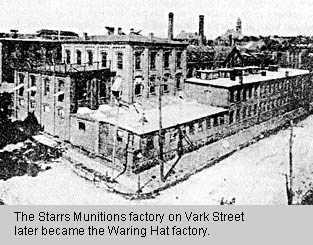
In Yonkers the rumors spread that rioters were headed for the Starrs Munitions Factory on Vark Street to steal firearms and ammunition.
The Yonkers village reserve guard had been called away to protect Washington DC from Lees Army of Northern Virginia and the city was defenseless and fear gripped the leading citizens that the large Irish population would join in the civil disorder.
A Home Guard of 300 men was formed and drilled in the streets. Mayor Everett Clapp, who owned the Starrs company, distributed weapons to his workers and to the Home Guard.
James Sheridan, a veteran of the first years of the war, was one of the few Irishmen to join the Home Guard. He was asked to wear his army uniform and stand the midnight watch at The Glenn (now Memorial Field), the most heavily Irish neighborhood of the community.
To the relief of all, nothing happened in Yonkers.
There are probably many reasons. The Irish in Yonkers had homes and were not about to endanger them (unlike New York City where most lived in crowded rented tenement flats) and, although most of the Home Guard were too old to really frighten anyone, the hundreds of armed employees at the munitions were surely a deterrent.
Perhaps the most important reason has never received proper notice: the pastor of St. Marys, Father Edward Lynch.
In a close knit Irish community like Yonkers (and in any Irish parish in those days) easily the most influential person was the parish priest.
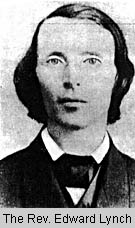
Father Lynch certainly knew his parishioners. He had just built St. Marys School and a major addition to St. Marys Church. Although he used his familys fortune (and his parishioners probably knew this), he had also personally collected twothirds of the funds from his parishioners by visiting their homes. His Irish parishioners were also grateful that he had brought the Sisters of Charity and the Christian Brothers to St. Marys School.
An ardent supported of the Union, he would have sent the word clearly to his people in Yonkers: resist any temptation to join in the rioting.
So beloved and respected was Father Lynch that he would have been obeyed with little or no ques tion. The reason Yonkers escaped the draft riots may have been as simple as that.
Meanwhile, hundreds of Yonkers men served (and suffered wounds and death) with honor in the Union army, especially in the Sixth Artillery, of primarily Yonkers origin.
Their service is honored by the monument that still stands today in front of Philipse Manor Hall, which then held the offices of the Village of Yonkers.
LINCOLN AND YONKERS
In the 1860 presidential election, Abraham Lincoln and the newly formed Republican Party won New York State by 60,000 votes. However, he lost New York City by 28,000 and Westchester County by 1,371.
Lincoln won the Town of Yonkers (comprised of the present City of Yonkers plus Highbridge and Riverdale) by three votes and won the Village of Yonkers (the Getty Square area) by 80 votes. The Second District, strongly Democratic and Irish, voted against him.
In 1864, winning his second term, Lincoln lost New York City by a twotoone margin. In the Irish sections he lost 90% of the vote.
In Yonkers Lincoln lost by 232 votes of a total of 1,978, a margin of 12%. The vote in the Irish sections went heavily against him. Westchester County also voted against the President but Lincoln won New York State and, of course, the nation.
On January 31, 1865, Congressman William Radford (for whom Radford street is named) and three other Democrats from New York, voted in favor of the constitutional amendment emancipating all slaves in the United States. Judged by history as one of the immortal four, Radford was voted out of office by his Yonkers constituents. The other three also lost their seats.
EDITORS NOTE: The above article is edited from a history of the parish compiled by the Rev. Msgr. Hugh Corrigan as part of the 150th Anniversary of the Church of St. Mary of the Immaculate Conception in 1998. St. Marys is the oldest Roman Catholic parish in Yonkers and was founded by Irish emigrants from An Gorta Mor (The Great Hunger) of 184652.