
 ountee Cullen was born on January 9, 1903 probably in Louisville, Kentucky. On a college application form he listed his birthplace as Louisville but on passports applied for between New York City was listed. In 1940 his wife insisted his place of birth was Louisville.
Countee Cullen was raised by his grandmother, Amanda Porter, and when she died in 1917 he went to live with the Reverend Frederick A. Cullen, pastor of the Salem Methodist Church at 129th Street and 7th Avenue in New York City. Formerly known as "Countee Porter," he assumed the name Countee Cullen" in 1918.
A student at P.S. 27 in the Bronx in 1916, he later attended De Witt Clinton High School at 59th Street and 10th Avenue. During he wrote for the school literary magazine, The Magpie and was associate editor in 1921 and editor of the Clinton News. He was also vice president of the senior class. The same year he won both an oratorical contest sponsored by the actor Douglas Fairbanks and thefirst place Magpie Cup in a citywide poetry contest sponsored by the Empire Federation of Women's Clubs with a poem entitled, "I Have a Rendezvous with Life."
Cullen attended New York University on a Regent's Scholarship from and was elected to Phi Beta Kappa as a junior. He wrote poetry for the university literary magazine, The Arch, and eventually became its poetry editor. In 1923 over 700 undergraduates from 63 colleges and universities submitted poems prize to the Witter Bynner contest sponsored by the Poetry Society of America and Cullen's, "The Ballad of the Brown Girl" won sec-ond prize. Carl Sandburg was one of the judges. Cullen won second prize won again in 1924. When he took first prize in the 1925 contest his poems had already been printed in Bookman, American Mercury, Harper's, Century, Nation, and Crisis. In his senior year of college his first collection of poetry, Color, was published and his second collection, Copper Sun was in print two years later.
Countee Cullen earned a Master of Arts Degree from Harvard and in 1927 won a Harmon Foundation Medal and cash prize for his work in literature. Arthur A. Schomburg and James Weldon Johnson received similar awards at the same ceremony in St. Mark's Church at 137th Street and St. Nicholas Avenue. Dr. Adam Clayton Powell of the Abyssinian Baptist Church was the master of ceremonies.
On March 19,1928, The New York Times reported that Cullen was one of 75 young Americans awarded $2,500 Guggenheim Scholarships to study abroad.
On April 9,1928 he married Yolande Dubois at the Salem Methodist Church in Harlem. A teacher in Baltimore, Yolande was the only child of W.E.B. Dubois, the founder and editor of the NAACP publication, The Crisis. After a brief honeymoon the couple went to France and Cullen pursued his Guggenheim research. A third volume of poetry, The Ballad of the Brown Girl, was published in 1928 and a fourth, The Black Christ and Other Poems, came the following year.
In 1934 Cullen began teaching English and French at Freder-ick Douglass Junior High School on West 140th Street in Harlem. He was faculty adviser to the literary club and taught James Baldwin. Both he and Baldwin were adopted by fundamental ministers, attended De Witt Clinton High School, edited the school's literary magazine and became celebrated writers.
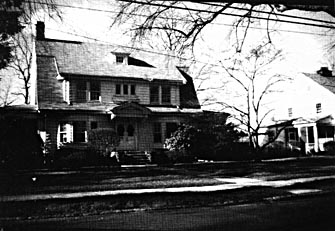
In the spring of 1944 Countee Cullen bought a nine room Dutch colonial house at 41 Grandview Boulevard in the Colonial Heights section of Yonkers. When The Herald Statesman interviewed him at the time he said, "I write when I can find the time."
He died on January 9,1946 at the age of 42 from complications resulting from high blood pressure. He was survived by his father; his second wife, Ida Mae Roberson Cullen; a stepdaughter, Mrs. Arthur Nimmons and her daughter, Duane Nimmons, all of Yonkers.
The New York Times reported Tuckahoe as his residence. Parts of Yonkers today have their mail delivered from the Scarsdale, Tuckahoe and Bronxville Post Offices. In 1946 the mail for Grandview Boulevard was probably delivered from the Tuckahoe Post Office, causing the error.
Cullen's funeral was January 13, 1946 at the Salem Methodist Church in Harlem and burial was in Woodlawn Cemetery in the Bronx. The overflow crowd in attendance at the church was estimated at 3,000.
During the last year of his life Cullen was writing the script for "St. Louis Woman," a musical based on a work by Arna Bontemps with music by Harold Arlen and lyrics by Johnny Mercer. It opened on Broadway in March 1946. Ironically, in 1946 W.C. Handy, the composer of "The St. Louis Blues" lived at 19 Chester Place in Yonkers, near to Cullen's home.
Countee Cullen's 'Victorian style" was influenced by John Keats and Edna St. Vincent Millay. Many of his poems had a racial or Christian theme but he wanted to be known just as a poet not merely a "Negro poet." He produced his best work early in his life. Cullen's poetry earned him the title of " Poet Laureate of the Harlem Renaissance.
[Tom Flynn]