

 n September 1609, Henry Hudson’s ship The Half Moon sailed up the river that now bears his name. It approached the present site of Yonkers and dropped anchor.
Here a number of bark huts were clustered about a spot where a stream flowed into the river, marking a native American settlement. The village was called Nappeckamack (rapid water settlement) and the stream was called the Neperah.
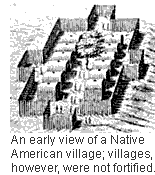
The native American villagers living on the banks of the Neperah were confederated with the Mohicans. They were of Algonquin lineage, Mohican tribe and Manhattes family. Their sachem, Tackarew, would later sell much of this land to the Dutch settler Adriaen van der Donck. (Another group, the Weckquaeskecks, occupied the area between what is today the Saw Mill River and the Bronx River.)
Born in Breda, Holland, Adriaen van der Donck had been graduated from the University of Leyden, had studied law and had been admitted to the bar before he ventured to the New Netherland colony in the capacity of sheriff of Rensselaerswyck, the great feudal estate near Fort Orange (Albany). He later moved south to New Amsterdam (New York City).
 In 1646, a year after his marriage to Mary Doughty, van der Donck asked the Dutch West India Company for his own patroonship. He was granted the land that would become Yonkers, with the understanding that he would buy it from the native Americans. The young patroon’s land extended from the Shatemuc (Hudson River) to the Aquehung (Bronx River) and from Spuyten Duyvil Creek to the Amackassin, the rivulet which flows into the Hudson near the northern boundary of the present City of Yonkers.
Van der Donck was known as De Jonkeer, which means “the young gentleman.” And his estate was known as Colen–Donck, which means “Donck’s colony.” Sometimes the estate was referred to as “De Jonkheer’s Landt” or as “Donckers.” And the English would call it “Youncker’s Land,” an appellation that was later shortened to “The Yonkers” and, finally, to Yonkers.
Though he built a sawmill and a gristmill on his new land and started building a house, van der Donck never lived in Yonkers, for he was called upon to make several trips back to Holland in the interest of the settlers who disliked Peter Stuyvesant. While in Holland on one such trip, van der Donck wrote a history of the New Netherland colony.
When Adriaen van der Donck died in 1655, he left his estate to his wife. Colen–Donck remained in her possession until 1667, when it was disposed of in several sales. What still remained of the property afterwards was divided into thirds and sold in 1672. One of the three purchasers was Frederick Philipse, who thus came to own a large part of “The Yonkers.” The land would remain in the hands of the Philipse family for more than one hundred years.

The first Philipses were a noble family from Bohemia. It is thought that they came to New Netherland in 1647 with Peter Stuyvesant. (The original spelling of the name, before it was anglicized, was Felypse or Felypsen.)
Three members of the Philipse family, each of whom was named Frederick, owned most of the territory within the bounds of the present city of Yonkers for 107 years (notably excluding Mile Square). Each of these men was known as “the lord of the manor,” but this meant no more than that the holder of the title was the owner of the property; this was not a feudal title.
Frederick Philipse, the purchaser in 1672 of part of the van der Donck property, was the first lord of the manor. Upon his death in 1702, the land passed to his grandson Frederick Philipse, who thereby became the second lord of the manor. When this Frederick died in 1751, his son, who was also named Frederick Philipse, became the third and last lord of the manor. Frederick’s Tory sympathies during the American Revolution cost him his land. It was confiscated by the state of New York in 1779.
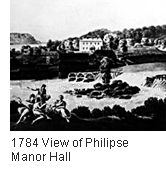
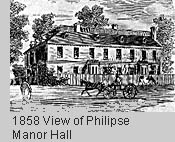
The first Frederick Philipse came to the New World as a carpenter in the employ of the Dutch West India Company. He later became a merchant and married a rich wife, Margaret Hardenbrock. Margaret died in 1690. In 1692 Frederick married the widow Catharina Van Cortlandt, who brought two fortunes to their union—one left her by her husband and one left her by her father. Frederick, who conducted a thriving trade with the Iroquois as well as with the East and West Indies, was a man of great influence in the colony and was for twenty years a member of the New York Common Council. The building which is today known as Philipse Manor Hall began as Frederick Philipse’s dwelling (he lived in the southern part of the present manor house, to which additions were added about sixty-three years later). It was erected on the north bank of the Nepperhan River near where the river flowed into the Hudson. This early portion of the house is built of bricks brought over from Holland in Mrs. Philipse’s ships as ballast.
The second Frederick Philipse built a chapel, which today forms part of St. John’s Church in Getty Square. He also enlarged the manor house and changed the entrance from the south side to the east side, as at present. Twice a year, on rent days, he feasted his tenantry. He died in 1751 and is buried in the Dutch Church at Sleepy Hollow.
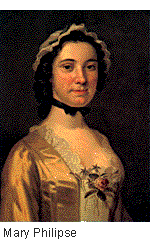
The third lord took over the estate in 1751 and refurnished the manor house and terraced the grounds. George Washington is believed to have been interested in Mary Philipse, the sister of the third lord, before her 1758 marriage to a British officer, Colonel Roger Morris. Mary’s wedding took place in the manor house. It is said that the affair was interrupted by the appearance of a tall man wearing a scarlet blanket, a native American, who prophesied to the assembled guests: “Your possessions shall pass from you when the eagle (the Americans) shall despoil the lion (Great Britain) of his mane (the colonies).” Years later, the lands of the Philipses were confiscated because of their Loyalist sympathies.
The population of Yonkers was small during the Philipse period. In 1708 a missionary reported 250 people living here.
The Philipse Manor House still stands in its original location. It is the oldest building in Yonkers, having survived the native American, the Dutch and the English periods of local dominance.
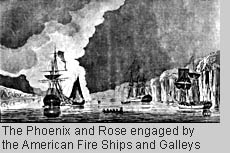
During the American Revolution lower Westchester became known as the “Neutral Ground” and was the site of a number of significant engagements. On August 16, 1776, the Americans won their first naval engagement with the British on the Hudson River. While anchored off Yonkers on this date, the British were surprised by two American fireships filled with combustibles, which destroyed one British ship, damaged another and caused the rest to sail downstream.
By the fall of the year, with George Washington’s troops having been defeated on Long Island (Battle of Brooklyn Heights) and with the British occupying most of Manhattan island, Major Charles Lee was given the chief command of American troops in Westchester. Troops under General Heath were stationed at Kingsbridge at what was called Camp Yonkers. A council of war was held there on October 16, attended by Washington, Lee, Heath and other officers, including Major Generals Spencer and Sullivan.
Spencer was sent to occupy Valentine Hill, the present site of St. Joseph’s Seminary, and Washington sent Colonel Rufus Putnam to find out more about the plans of the British.
Putnam rode through Lower Yonkers (an area later to become part of the Bronx). After crossing the river at Williamsbridge he followed the White Plains Road. From the heights near St. Paul’s Church in Mount Vernon he saw a small body of British troops. He detoured around them and rode on toward Scarsdale to determine how far General Howe had advanced.
Putnam learned that the British were at Mamaroneck, only eight miles from White Plains, where Washington was gathering stores and ammunition. He hurried back to Eastchester. Though he had been riding for twelve hours and was dead tired, he decided to go back at once to report to Washington in Kingsbridge.
Putnam crossed the Bronx River over Valentine’s Bridge. Here he discovered that his old friend General Lord Stirling had established a camp in the hills now known as Colonial Heights. This camp was the advance post for Washington’s army. Putnam procured a fresh horse and set out over what is now called Tuckahoe Road to Saw Mill River Road. He then rode on to the Albany Post Road at Philipse’s and thence to Kingsbridge. He reached Kingsbridge at 9 P.M.
The news that Putnam conveyed to Washington caused Washington to hurry northward to countermove General Howe.
Putnam was then sent back almost immediately to Stirling, with orders for Stirling to proceed to White Plains. Accompanied by Putnam, Stirling was on the march before daybreak and arrived at White Plains at 9 A.M.
By the time he reached White Plains with Stirling, Putnam had been riding almost continuously for twenty–eight hours and had covered fifty miles. It has been said that his ride deserves to rank in importance with that of Paul Revere for its contribution to the success of the American cause in the war for independence.
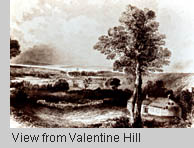
On October 21 Washington moved his headquarters to Valentine Hill. At the same time Heath, Sullivan and Spencer were ordered to move their divisions to White Plains and General Lee was assigned the task of bringing up the rear with the baggage.
Lee began a slow march over Mile Square Road. When he reached Colonial Heights, he sent a detachment across the Bronx River to Ward’s Tavern. In Eastchester they killed ten Hessians. The Hessians retaliated by raiding Lee’s column and capturing much of his baggage.
A terrific battle took place on Chatterton Hill following General Howe’s move from Scarsdale; neither side won. The Americans fell back to the main fortifications north of White Plains, where Howe was unwilling to attack them. Howe then moved his army down to Kingsbridge.
Leaving Lee in command of one–half of the force in the hills north of White Plains, Washington proceeded to the Hudson, crossed it and retreated south to New Jersey. The bulk of the British army moved to Kingsbridge on November 12, preparatory to the attack on Fort Washington on November 16. After securing that fort, they moved to take Fort Lee across the river. At 9 P.M. on November 19, Lord Cornwallis embarked about 5,000 men from Little Nepperhan Harbor at the Manor House and captured Fort Lee the next morning.
Two months later, on January 17, 1777, Manor Hall came back into possession of the American army. Many times the Manor House and the surrounding country were possessed, in turn, by the American and British armies. Both armies used St. John’s Church as a hospital. Two other points of local interest: Almost daily during the months of September and October, 1776, a horseman rode through Yonkers carrying communications from George Washington to the Americans’ state government at Fishkill. Just east of Saw Mill River Road, where today the waters of the Fortfield Reservoir lie, was the Fort Field of Revolutionary War fame. It was called a fort because the Hessians, encamped in that location during the war, constructed earthworks there. The American Revolution brought great changes to Yonkers. No longer was it part of the Manor of Philipsburgh, for the power of Frederick Philipse was at an end. The New York State Legislature decreed that the Philipse land was to be sold in plots not to exceed 500 acres, or one farm. The Legislature also divided New York State into sixteen counties. One of these counties was Westchester. Westchester was divided into twenty–one towns. One of these towns was Yonkers. This town of Yonkers was bounded on the north by the town of Greenburgh, on the east by the middle of the Bronx River, on the south by the town of Westchester and Spuyten Duyvil Creek, and on the west by the Hudson River. The first census, in 1790, counted 1,125 inhabitants, including 170 slaves. There were twenty–seven more males than females.