

 At the dawn of the 20th Century Yonkers was a city with a population of 47,931. Electric trolleys were replacing horse cars all over the country. In Yonkers the only public transportation, a horse–drawn stage coach operating between Getty Square and Mount Vernon, had given way to the trolley in 1886. Other trolley lines were built along Warburton Avebue to Hastings and then out to Uniontown, from the foot of Main Street to the Moquette Mill on Nepperhan Avenue, along South Broadway to Ludlow Street and from Getty Square along Palisade Avenue, Park Avenue and Shonnard Place to North Broadway.
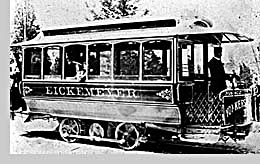 The Yonkers trolley mechanism was developed by Rudolph Eickemeyer, assisted by the brilliant young immigrant, Charles P. Steinmetz, who was later to become a world–recognized “electrical wizard.” On May 8, 1908, the cornerstone of the present City Hall was laid. At that time, too, Yonkers received its charter as a second–class city. (It had been a third–class city since its incorporation in 1872.)
 The Woman’s Institute, founded in 1880 by a group of earnest young women headed by Mary Marshall Butler, was pioneering in nearly all forms of social and civic work in the city. Launched as a free circulating library for self–supporting young women, the Institute had by this time established an employment bureau for domestic workers and was also providing cooking classes for young girls enrolled in the public schools. For fifteen cents, young working women could avail themselves there of a hot lunch consisting of soup, meat, dessert and coffee. The Civic League of the Institute was responsible for improvements in the city jail, the placing of receptacles for rubbish on the sidewalks, the organization of the Yonkers Society for the Prevention of Cruelty to Animals, the city’s purchase of vacant lots on Park Avenue as a site for Grant Park and many other civic improvements.
As young women were active at the Institute, young men and old were gathering at the Hollywood Inn, which was located on the southwest corner of South Broadway and Hudson Street. Opened in 1893 at 18 Main Street (“as a substitute for the saloon”) under the leadership of the rector of St. John’s Episcopal Church, “The Inn” was a success from the start. William F. Cochran of the carpet shop made possible the construction of the Inn’s new building at Broadway and Hudson, an imposing edifice which was equipped with billiard and pool parlors, library and reading room, gymnasium, swimming pool, bowling alleys, lodge rooms and a large assembly hall.
 At the same time the Music Hall, located in the Warburton Building which stood just to the north of the Manor Hall, was featuring stage hits, and the Columbia Concert Garden on Main Street was a local venue for vaudevillians.
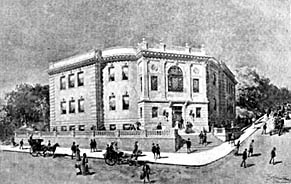
In 1901 John Kendrick Bangs, a nationally known humorist and writer and a trustee of the Yonkers Public Library, with Mayor Leslie Sutherland wrote to the steel magnate and philanthropist Andrew Carnegie, asking for a gift of $50,000 for a library building. The reply came, “Provide a suitable site and agree to maintain a public library at a cost not less than $5,000 a year.” The gift was accepted, plans for a building were submitted and, on July 9, 1904, the new library building was opened for service. It stood on the northeast corner of Broadway and Nepperhan Avenue for almost eighty years.
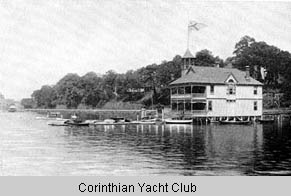
For outdoor recreation, Yonkers residents turned to bicycles in increasing numbers, staged parties aboard decorated and illuminated trolley cars and traveled to Uniontown, where a ferris wheel, carousel and beer parlor could be found. And always there was the Hudson River, where the young learned to swim in an era before PCBs, and where adults could swim, fish or picnic. The Corinthian, the Palisade and the Yonkers Yacht Clubs were flourishing organizations. The clubs would celebrate Independence Day with rowing, swimming and tub races. In the evening, the display of colored lights, lanterns and fireworks was an impressive sight.
Alpine—“across the river”—was a favorite visiting place for people of Yonkers. It was from Alpine that they boarded steamboats until Lemuel Wells built his wharf. The “rowboat” ferries had been replaced by small steamboat ferries in 1874; and Mr. Gould, who operated the ferry named “Alpine,” carried as many as 800 persons across the river on Sundays and holidays for twenty–five cents. (When competition eventually led him to reduce the fare to ten cents, he still made a profit.) Ferry service to Alpine was modernized in 1923 when the Westchester Ferry Company began operation, and two sidewheel paddle boats were used to carry passengers and vehicles. The ferry service to Alpine would continue until December 16, 1956. (By the end of ’56, the ferry could no longer compete with the convenience and speed of the Tappan Zee Bridge which had opened the year before.)
A climax to the story of Yonkers just after the turn of the century was the Hudson–Fulton Celebration, which began on September 25, 1909, and lasted for two weeks. The festivities of the first week centered in New York City and those of the second on the upper Hudson. Replicas of the “Half Moon” and “Clermont” were escorted up the river as far as Newburgh by a flotilla of naval vessels and commercial ships. Old Home Week was celebrated in most river towns and cities, and Yonkers had a memorable one. This celebration was a backward glance, but momentous changes were not far off.